ГуманитариЙ актуальные проблемы гуманитарной науки и образования
Russian Journal of the Humanities
ISSN 2078-9823 (Print)
ISSN 2587-7879 (Online)


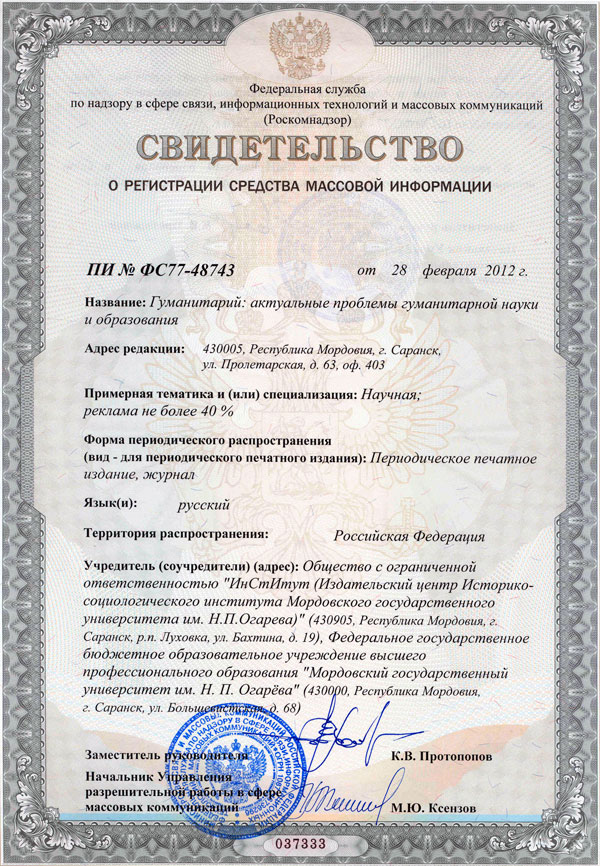
Certificate of registration
Navigation
ISSN 2078-9823 (Print), ISSN 2587-7879 (Online)
DOI: 10.24412/2078-9823.073.026.202601.075-083
УДК 119
Alexander A. Somkin1, Aleksey V. Arapov2
National Research Ogarev Mordovia State University (Saransk, Russia)
1 e-mail: alexsomkin@mail.ru
2 e-mail: i@aarapov.ru
The Problem of Interpersonal Interaction in the Digital Space of Future Society (Based on the Works by Sergei Lukyanenko)
Abstract
Introduction. This article presents a philosophical perspective on the trilogy by Russian science fiction writer Sergei Lukyanenko: “Labyrinth of Reflections”, “False Mirrors”, and “Transparent Stained-Glass Windows”. The author identifies key points for a philosophical analysis of the literary text: the interaction between humans and digital space, and the formation of an artificial, or “object-centered, sociality”, characterized by a shift in the focus of communication processes from living to non-living objects. Parallels between several plot lines and ideas of trans- and posthumanism are noted, particularly the attainment of immortality through the emergence of an “afterlife” in cyberspace and the transformation of anthropocentrism due to the deep penetration of digital technologies into human life. The books also analyze the eternal questions of philosophy and ethics: violence as a factor in civilizational development, the problem of choice, the boundary between good and evil, permissiveness in conditions of anonymity, and the negative side of scientific and technological progress.
Materials and Methods. The material for the analysis is the science fiction trilogy by Sergei Lukyanenko (2003). Philosophical, sociocultural, anthropological, and axiological methods were used. Hermeneutic and analytical methods were also applied. The article presents primarily the author’s vision of Lukyanenko’s text. To further substantiate some points of the analysis, the materials of Russian and foreign scholars were used: L. A. Belyaeva and O. N. Novikova, who analyze gaming culture; V. M. Maslov’s study of high technologies and the posthuman future; K. Knorr-Cetina’s work dedicated to object-centered sociality; articles by A. A. Druzhinina, N. N. Kozhevnikov, and V. S. Danilova, which substantiate the philosophical approach to the science fiction genre.
Results. Lukyanenko’s trilogy embodies philosophical ideas that reflect the problems of the future. Certainly, there are many scenarios for the development of society and humanity, but these books, despite their fantastical foundation, explore options whose foundations are already laid in the present. This concerns the expanding use of digital technologies, improved internet access, the increasing sophistication of equipment that creates the illusion of reality, and the addictive nature of gaming culture. As a result, it is concluded that science fiction is one way to frame future problems that are being shaped in the present and that need to be discussed now.
Discussion and Conclusion. The article presents propositions that can serve as a basis for further scholarly discussions. The rapid development and expansion of digital technologies pose the challenge for science and society to understand the potential consequences of this process. Humanity is entering an era where new methods of processing, storing, and transmitting information are fundamentally changing the nature of human life and the principles of social existence. By sketching the contours of a probable future, science fiction writers not only present questions about the further development of civilization for consideration but also, to some extent, direct this development in a certain direction, revealing the negative consequences of scientific and technological progress. Consequently, the scientific community should not ignore science fiction works that contain profound socio-philosophical thoughts and forecasts of the future.
Keywords: Sergei Lukyanenko, “Labyrinth of Reflections”, “False Mirrors”, “Transparent Stained Glass”, science fiction, digital space, transhumanism, posthumanism, postsecularity.
For citation: Somkin A. A., Arapov A. V. The Problem of Interpersonal Interaction in the Digital Space of Future Society (Based on the Works by Sergei Lukyanenko). Gumanitarian: aktual’nye problemy gumanitarnoi nauki i obrazovaniia = Russian Journal of the Humanities. 2026; 26(1): 75–83. (In Russ.) DOI: 10.24412/2078-9823.073.026.202601.075-083.
© Ogarev Mordovia State University. History and Sociology Institute, 2017
68, Of. 411, Bolshevistskaya St., 430005, The editorial office of the scholarly journal «Russian Journal of the Humanities»
Tel.: (8342) 24-25-90; 27-07-11, Fax: (8342) 24-25-90, E-mail: jurnal-econom-hist@isi.mrsu.ru
Designed by A. Napalkov, Email: napalkov@isi.mrsu.ru