ГуманитариЙ актуальные проблемы гуманитарной науки и образования
Russian Journal of the Humanities
ISSN 2078-9823 (Print)
ISSN 2587-7879 (Online)


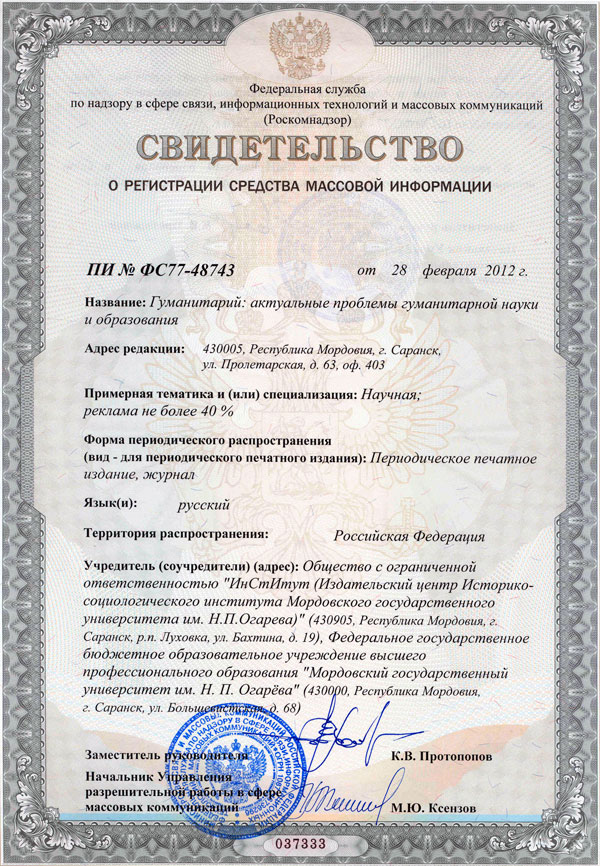
Certificate of registration
Navigation
ISSN 2078-9823 (Print), ISSN 2587-7879 (Online)
DOI: 10.24412/2078-9823.073.026.202601.039-051
УДК 908.470
Demyan A. Ivochkin1, Philip D. Krokhin2
Smolensk Orthodox Theological Seminary (Smolensk, Russia),
1 e-mail: idar78@mail.ru
2 e-mail: supernwell@yandex.ru
Smolensk Hodegetria Brotherhood: Religious and Educational Aspects of Activity in the Early Years of Soviet Power
Abstract
Introduction. This article examines the formation and activities of the Smolensk Hodegetria Brotherhood – a unique phenomenon in the church life of Smolensk in 1918–1921. The purpose of the article is to analyze the causes of the emergence of the brotherhood, its charter, goals and objectives of activity. The issue of internal contradictions among the members of the brotherhood and the internal political struggle among them is considered. The issue of the practical implementation of the tasks of the Hodegetria Brotherhood, i.e. its real activity, is analyzed.
Materials and Methods. The study is based on unpublished materials from the State Archives of the Smolensk Region. The study uses a systematic approach as its methodological concept, which focuses on the individual elements of the problem in relation to each other and the impact of external conditions on them. The article employs general historical methods, such as the problem-chronological and historical-genetic methods. The study is based on the authors’ proposed system of diocesan life, which includes the bishop, the clergy, and the parishioners.
Results. For the first time in regional historiography, the activities of the diocesan brotherhood that emerged after the October Revolution of 1917 are examined. Despite the clergy’s experience in the pre-revolutionary diocesan Abrahamian Brotherhood, the new organization differed in its objectives. While the clergy paid attention to public education before the revolution, the new brotherhood, emphasizing its differences from the Abrahamian Brotherhood, aimed primarily to preserve the Assumption Cathedral and its shrine, the Hodegetria, and to participate in the religious life of Smolensk (education and the election of a bishop).
Discussion and Conclusion. The Hodegetria Brotherhood was a unique phenomenon in the church life of the Smolensk region. Established in 1918 as a governing body for the Assumption Cathedral, it later transformed into a church structure of citywide significance. In 1920, the brotherhood faced internal disagreements, which did not prevent it from continuing its activities and expanding them in 1921. Despite its primary objective of preserving the Dormition Cathedral and its main shrine, the Smolensk Icon of the Mother of God Hodegetria the brotherhood actively participated in the social, political, and ecclesiastical processes taking place in the city.
Keywords: Orthodox Church in the 20th century, Smolensk Diocese, the Hodegetria Brotherhood, clergy, parish council, and the brotherhood charter.
For citation: Ivochkin D.A., Krokhin P. D. Smolensk Hodegetria Brotherhood: Religious and Educational Aspects of Activity in the Early Years of Soviet Power. Gumanitarian: aktual’nye problemy gumanitarnoi nauki i obrazovaniia = Russian Journal of the Humanities. 2026; 26(1): 39–51. (In Russ.) DOI: 10.24412/2078-9823.073.026.202601.039-051.
© Ogarev Mordovia State University. History and Sociology Institute, 2017
68, Of. 411, Bolshevistskaya St., 430005, The editorial office of the scholarly journal «Russian Journal of the Humanities»
Tel.: (8342) 24-25-90; 27-07-11, Fax: (8342) 24-25-90, E-mail: jurnal-econom-hist@isi.mrsu.ru
Designed by A. Napalkov, Email: napalkov@isi.mrsu.ru