ГуманитариЙ актуальные проблемы гуманитарной науки и образования
Russian Journal of the Humanities
ISSN 2078-9823 (Print)
ISSN 2587-7879 (Online)


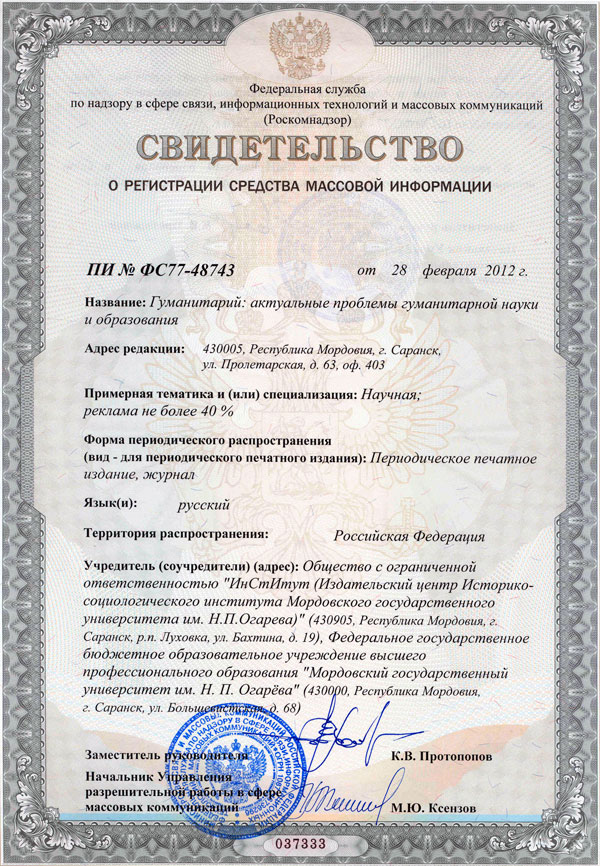
Certificate of registration
Navigation
ISSN 2078-9823 (Print), ISSN 2587-7879 (Online)
DOI: 10.24412/2078-9823.073.026.202601.084-098
УДК 159.922.2
Sergey I. Balyaev1, Zhanna G. Garanina2, Sergey N. Nikishov3, Irina S. Nikishova4
National Research Ogarev Mordovia State University (Saransk, Russia)
1 e-mail: balyaevsi@mail.ru
2 e-mail: garanina23@mail.ru
3 e-mail: serg-n79@yandex.ru
4 e-mail: isosipova@yandex.ru
An Empirical Assessment of the Level of Ethnic Tolerance among University Students of Different Ages
Abstract
Introduction. Contemporary challenges in the increasingly saturated information space (including the media and online environment), such as the spread of xenophobia, ideas of ethnic radicalism, and discrimination, highlight the need for targeted development of a tolerant consciousness as the basis for stable and secure coexistence between diverse population groups. In a context where adherents of different cultural norms and values clash, the issue of developing a culture of mutual understanding and respect for diversity naturally becomes relevant. The issue of ethnic tolerance is particularly significant for children and youth.
Materials and Methods. One of the methods used in this study was a theoretical analysis of existing approaches to the problem of ethnic tolerance. The leading method for empirically assessing the state of ethnic tolerance was testing (E. Bogardus’s Social Distance Scale). A comparative analysis of the obtained data was conducted using the Mann-Whitney U-test. To study ethnic tolerance among young people of different ages, we conducted an empirical study among representatives of two age groups: the younger group (aged 18–21) and the older group (aged 26–35). The total sample size was 155 people (students at National Research Ogarev Mordovia State University).
Results. Respondents in the older age group tend to maintain close social distance only with representatives of their own ethnicity, and maintain a moderate social distance only with Tatar and Belarusian ethnic groups, reflecting their territorial and subjectively perceived cultural proximity to these peoples. However, they tend to maintain a higher social distance from representatives of most ethnic groups from near and far abroad compared to the younger age group.
Discussion and Conclusion. The identified signs of intolerance among older students toward most of the subjects can also be interpreted in the context of the age characteristics of this sample. The unconscious projection of negative attitudes and experiences in self-perception onto others («outsiders») is one of the individual’s psychological defense mechanisms. As a result, intolerance often arises as a natural way to channel manifestations of self-aggression.
Keywords: tolerance, intolerance, social distancing, students, Russians, Mordvins, neighboring countries, distant countries.
Acknowledgments: This article was prepared with the financial support of the Svetoslav Russian Civilization Foundation as part of research project No. 2/2023 on the topic “Development of Ethnic Identity and Ethnic Attitudes among Russian Youth”.
For citation: Balyaev S. I., Garanina Zh. G., Nikishov S. N., Nikishova I. S. An empirical assessment of the level of ethnic tolerance among university students of different ages. Gumanitarian: aktual’nye problemy gumanitarnoi nauki i obrazovaniia = Russian Journal of the Humanities. 2026; 26(1): 84–98. (In Russ.) DOI: 10.24412/2078-9823.073.0265.202601.084-098.
© Ogarev Mordovia State University. History and Sociology Institute, 2017
68, Of. 411, Bolshevistskaya St., 430005, The editorial office of the scholarly journal «Russian Journal of the Humanities»
Tel.: (8342) 24-25-90; 27-07-11, Fax: (8342) 24-25-90, E-mail: jurnal-econom-hist@isi.mrsu.ru
Designed by A. Napalkov, Email: napalkov@isi.mrsu.ru